


By Stanley Nkwazema—
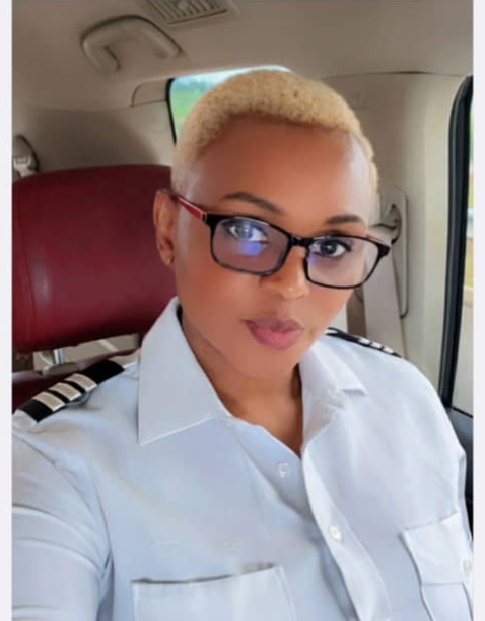
As Cross River State builds a new aviation future around Cally Air, one name deserves to be brought back into the conversation: Captain Cassandra Idagbo.
Not because she needs rescuing from obscurity, nor because history should be rewritten to suit today’s political narratives, but because long before Cross River began speaking with renewed confidence about building an aviation industry of its own, a Cross River woman had already broken an important barrier in Nigerian aviation.
Captain Cassandra Idagbo, popularly known as “Cassie Duke,” is widely identified as Cross River State’s first female pilot. Her pioneering achievement deserves a permanent place in the state’s institutional memory.
Her journey into aviation was not the straightforward story of someone born into a cockpit. In an earlier account of her life, she recalled that an uncle who was a pilot introduced her to the cockpit as a child. By about the age of five, she was already telling her mother that she wanted to fly.
Life initially took her in another direction. She studied French and later entered the aviation industry through cabin service, working as a member of cabin crew before deciding to pursue the more demanding path of becoming a pilot.
She eventually travelled to the United States for flight training before returning to Nigeria to pursue a professional flying career. She did not simply inherit a cockpit seat—she worked her way towards it, at a time when women remained a small minority in the aviation profession.
A daughter of Cross River’s cultural heritage, Cassandra is the daughter of the late Chief Charles Effiom Duke, a prominent Cross River cultural and entertainment personality.
Her father’s legacy was rooted in culture, community and public life—not simply entertainment, but also creating opportunities and nurturing talent.
Her marriage to Rt. Hon. Legor Idagbo has also connected her to the wider public life of Cross River. Legor Idagbo served in the House of Representatives representing the Bekwarra/Obudu/Obanliku constituency.
The state is not ignoring Cassandra’s contribution. She is among the 100 leading ladies in Cross River State slated to be honoured by the state government—a recognition that comes at a time when Cross River is seeking to build a stronger aviation future.
But perhaps the greater value of such an honour lies not only in celebrating what Cassandra has already accomplished, but in recognising what her experience can still contribute. With more than two decades of experience spanning aviation, business and advocacy for women in the industry, she represents more than a pioneering chapter in Cross River’s past—she represents an available resource for its future.
The question before the state is whether recognition will translate into legacy. Can her story become a mentorship programme? Can her experience help shape aviation policy and human-capital development? Can young girls across the state see in her not simply an honouree, but a possibility?
Captain Cassandra Idagbo did not wait for Cross River to become an aviation state before entering the cockpit. She entered the cockpit first. The challenge before Cross River is to connect the ambition of Cally Air with the precedent she represents—not merely to acquire aircraft, but to build people.


