


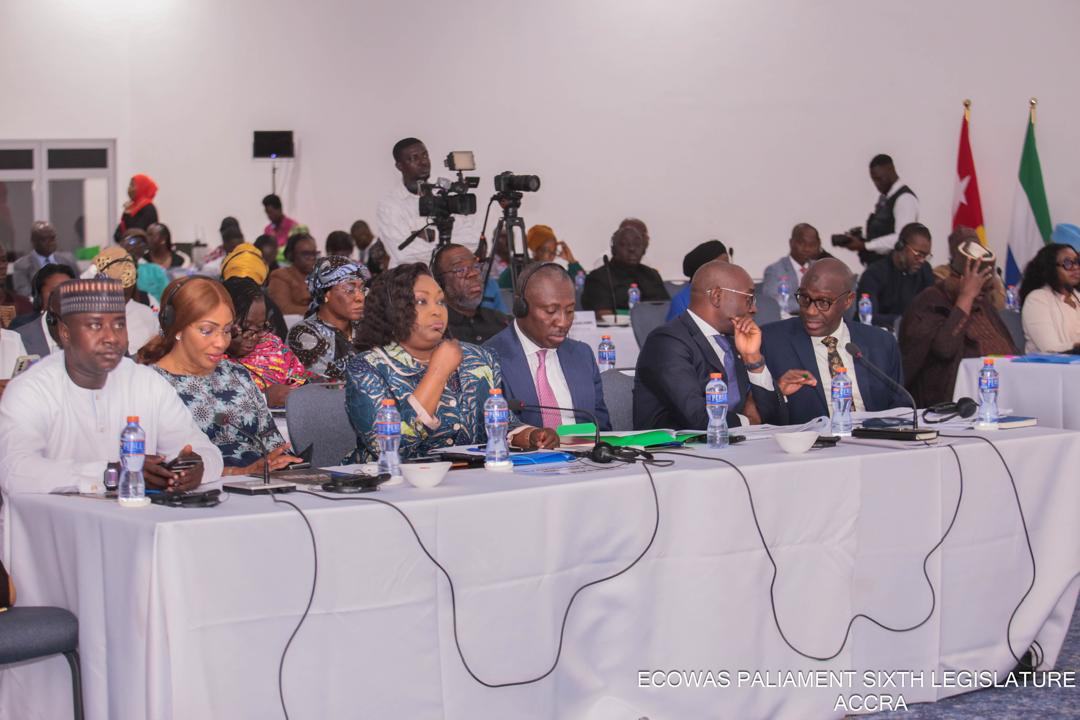
Climate change is fuelling population displacement and threatening regional stability across West Africa, experts warned on Monday as the Second Extraordinary Session of the ECOWAS Parliament opened in Accra.
The warning was issued at the Second Extraordinary Session and Second Parliamentary Seminar under the theme: “Climate Change as a Driver of Environmental Degradation, Population Displacement and Rising Insecurity in the ECOWAS Region.” The session will run from 21 to 28 September 2026 in Accra, Republic of Ghana.
Experts told lawmakers that rising temperatures, extreme weather, drought, unpredictable rainfall, flooding, rising sea levels, and land degradation are placing direct pressure on livelihoods, critical infrastructure, and security.
Opening the proceedings, the Speaker of the ECOWAS Parliament, Hadja Memounatou Ibrahima, said the session was convened at a critical time for the region.
She drew attention to Ghana’s Founders’ Day, marking the birth of Ghana’s first president, Dr Kwame Nkrumah, and called on participants to honour his vision of a free and united Africa. A minute’s silence was observed in his honour.
Dr Derek Sarfo-Yiadom, Senior Programme Officer at the Climate Change and Ozone Directorate of Ghana’s Environmental Protection Authority, stated that climate hazards were no longer distant threats.
“Climate hazards are with us,” he noted, listing extreme heat, drought, heavy and unpredictable rainfall, and rising sea levels as growing concerns.
Sarfo-Yiadom explained that seasonal temperatures have risen by between one and three degrees Celsius since 1970, driving intense heatwaves and unpredictable weather.
He lamented that changing rainfall patterns are increasing flood risks while drought and heat are crippling farming, identifying farmers, low-income communities, coastal settlements, and displaced populations as the most vulnerable.
He deplored the fact that homes, irrigation, electricity, transport networks, ports, markets, and public services are all at risk.
However, he warned that such impacts become disasters when exposed communities lack the capacity to cope, noting that climate pressure is already contributing to displacement and conflict in agriculture-dependent communities.
He called for increased investment in adaptation, flood-proof zoning, the expansion of climate-risk mapping, early-warning systems that reach vulnerable communities, and accountability for climate-related spending.
For his part, the Principal Officer for Climate Change and Climate Services at the ECOWAS Commission, Mr Raoul Kouame, said ECOWAS must harmonise regional climate policies and support member states in implementing their commitments under the Paris Agreement.
“The challenge is no longer just to define climate commitments,” Kouame said.
He identified institutional fragmentation, differences in national capacity, and difficulties accessing climate finance as the primary obstacles to action.
Kouame advocated stronger coordination between regional and national institutions, alongside mechanisms to help countries align national frameworks with regional structures.
He stressed that cooperation must encompass climate services, early-warning systems, forest and ecosystem protection, carbon markets, and access to finance.
The shortfall remains immense. The ECOWAS Regional Strategy for Access to and Mobilisation of Climate Finance, adopted in 2022, estimated the region’s climate financing needs at $294 billion, based on conditional requirements contained in NDCs 2.0. ECOWAS officials have warned that 32 million West Africans risk displacement, with $294 billion needed to tackle the crisis.
In 2024, the Commission initiated a new regional process, in line with ECOWAS Vision 2050 and the African Union’s Agenda 2063, to develop a harmonised framework for a regional carbon market platform.
Dr Abdou Ali, a climate, water, and meteorology expert with the Permanent Inter-State Committee for Drought Control in the Sahel (CILSS), told lawmakers that West Africa has faced similar crises before.
He noted that CILSS itself was created in 1973 during the region’s first major drought, following the devastating droughts of 1968–1970, stating that its core mandate remains food security and combating drought and desertification.
Ali emphasised that regional cooperation is essential because climate risks do not stop at national borders. He listed agriculture, coastal areas, biodiversity, disaster risk, and human displacement as key areas requiring coordinated adaptation, adding that climate action must be integrated into policies spanning agriculture, forestry, energy, transport, industrialisation, and waste management.
He stressed that regional strategies require adequate financing, stronger institutions, and effective implementation mechanisms.
The presentations converged on a single point: adaptation measures must account for the needs and livelihoods of affected communities to avoid creating new vulnerabilities.
Parliamentarians are now holding closed-door deliberations on the expert presentations.


