


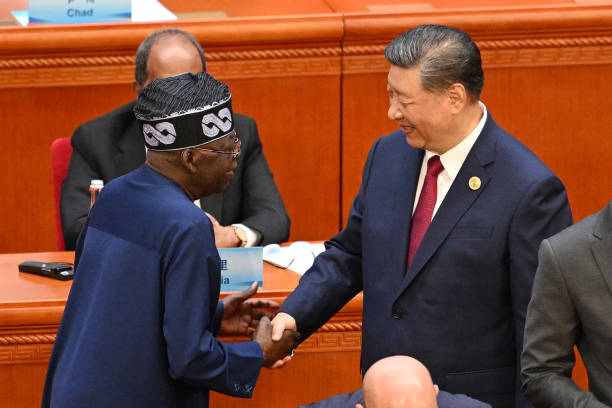
China has moved to deepen its strategic economic partnership with Nigeria beyond infrastructure and conventional trade, inviting Abuja to join a global artificial intelligence cooperation platform as bilateral trade between the two countries climbed to $18 billion in the first half of 2026.
The Chinese Ambassador to Nigeria, Yu Dunhai, made the proposal in Abuja on Wednesday at a reception marking the anniversary of the founding of the People’s Republic of China. Beijing is seeking stronger cooperation with Nigeria in artificial intelligence, industrialisation, digital technology, and the green and blue economies.
Yu said China was ready to align its 15th Five-Year Plan with President Bola Ahmed Tinubu’s Renewed Hope Agenda, describing industrialisation and emerging technologies as areas with significant potential for expanding bilateral cooperation.
He specifically invited Nigeria to join the World Artificial Intelligence Cooperation Organization, stating that participation would enable the country to share in global technological development.
The proposal comes as economic exchanges between the two countries continue to expand. Yu disclosed that bilateral trade reached $18 billion in the first half of the year—representing a 35 per cent increase—while Chinese imports from Nigeria surged by 81 per cent.
The ambassador’s figures underscore the growing scale of the relationship, but Beijing’s latest overture also shifts attention towards how Nigeria can translate expanding market access and technological cooperation into greater domestic production, value addition, and export capacity.
Yu highlighted China’s zero-tariff treatment for 53 African countries as another opportunity for African producers to increase access to the Chinese market.
He noted that the policy had contributed to a 24 per cent increase in Chinese imports from Africa in May and June, adding that Nigeria could benefit from this expanding market if its producers met the required quality, supply, and market standards.
The envoy also commended the economic policies of the Tinubu administration, stating that the government’s structural reforms, macroeconomic stabilisation measures, and efforts to improve the business environment had strengthened Nigeria’s economic recovery and created conditions for deeper cooperation with China.
‘Our future cooperation holds boundless potential,’ Yu said, stressing that both countries could deepen collaboration through innovation, openness, and mutual support.
This renewed emphasis on technology and industrialisation comes as Nigeria and China mark 55 years of diplomatic relations—a relationship that has evolved from basic trade into extensive cooperation across infrastructure, energy, transport, healthcare, and technical development.
Reflecting on his two years in Nigeria, Yu praised the resilience and determination of the Nigerian people, describing the ‘Naija spirit’ as a quality that had greatly impressed him during his travels across the country.
He added that relations between Beijing and Abuja had entered a new phase under the leadership of Chinese President Xi Jinping and President Tinubu.
On China’s economic trajectory, Yu noted that the country’s economy grew by 4.7 per cent in the first half of the year, supported by emerging sectors such as artificial intelligence, robotics, and innovative pharmaceuticals. He also pointed to China’s broader international initiatives in data and artificial intelligence as part of Beijing’s effort to promote technological cooperation with developing nations.
Speaking at the event, the Director-General of the Nigeria-China Comprehensive Strategic Partnership and Minister of Power, Joseph Tegbe, said Nigeria valued China’s contribution to major infrastructure projects and other areas of economic development.
Tegbe cited the Lekki Deep Sea Port, railway modernisation, and the Zungeru Hydroelectric Power Station as key examples of projects where Chinese investment, financing, and engineering had played significant roles.
He added that Nigeria also appreciated Chinese cooperation in healthcare, cultural exchanges, and technical trade.
Tegbe further commended China’s zero-tariff programme for Nigerian producers and reaffirmed Nigeria’s commitment to the One-China policy, recognising the government of the People’s Republic of China as the sole legal representative of China.
Also speaking at the reception, the National Chairman of the Allied Peoples Movement and Chairman of the Inter-Party Advisory Council, Yusuf Dantalle, urged Nigerians to draw lessons from China’s long-term approach to national development.
Dantalle remarked that China’s economic transformation had required sacrifice, discipline, political stability, and a sustained emphasis on collective development.
This latest overture places technology and market access at the centre of the next phase of Nigeria-China relations, potentially expanding the partnership from heavy infrastructure projects to artificial intelligence, digital innovation, and industrial value chains.


