


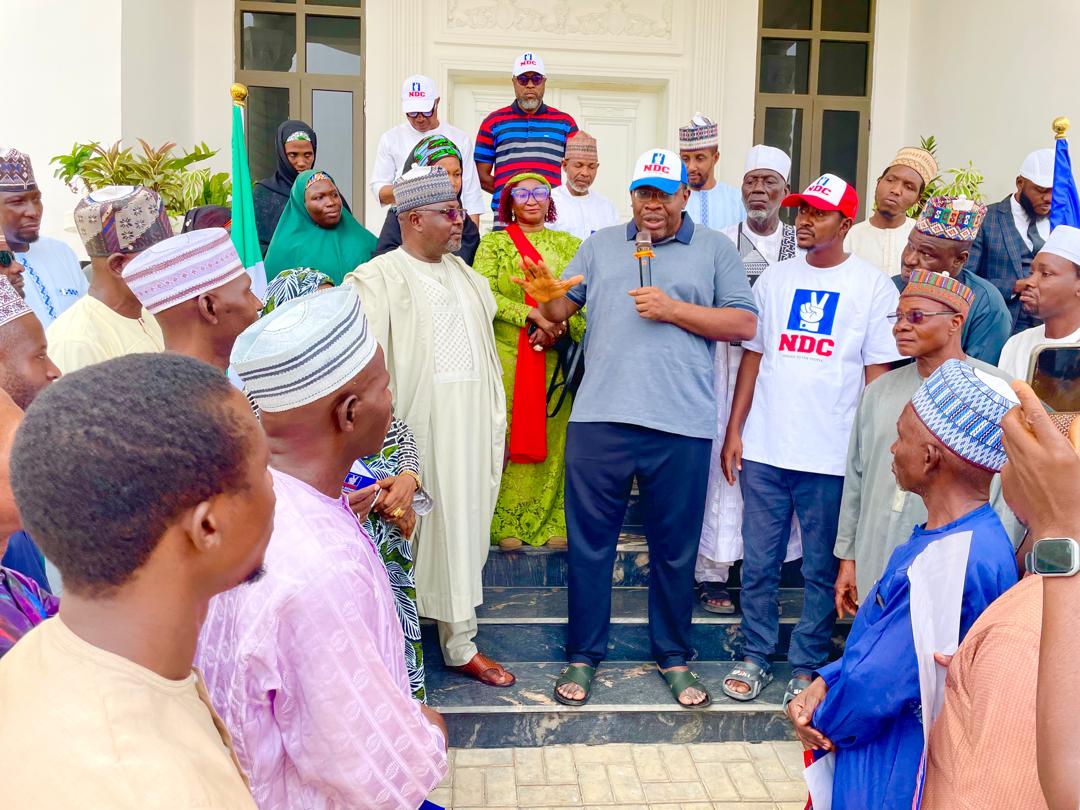
Nigeria’s fractured political scene is bracing for a shake-up. Just weeks old, the Nigeria Democratic Congress (NDC), led by Senator Henry Seriake Dickson, is rapidly attracting politicians and a citizenry hungry for change. Positioning itself as a vital lifeline for a struggling democracy, the NDC champions grassroots participation and citizen funding – a stark departure from Nigeria’s traditionally patronage-driven politics. Dickson is actively courting members from across the political spectrum, framing the NDC not as a party, but your party, and a crucial platform to “rescue Nigeria’s endangered democracy.” While facing formidable challenges, the NDC’s early momentum – fuelled by high-profile defections and a modern digital registration drive – signals a potential realignment in a landscape dominated by established, and increasingly discredited, giants. ROLAND OGBONNAYA writes
The Nigerian political landscape, often characterised by entrenched power structures and a wearying cycle of broken promises, has recently witnessed the emergence of a new contender. The Nigeria Democratic Congress (NDC), barely weeks old, is already generating a palpable buzz, attracting disaffected politicians and, crucially, the hopeful attention of a citizenry yearning for genuine change. Led by the charismatic and principled Senator Henry Seriake Dickson, the NDC is positioning itself not merely as another party, but as a vital lifeline for a democracy perceived to be drifting towards peril.
The unveiling of the NDC’s digital membership registration platform in Abuja earlier this week was more than a logistical step; it was a symbolic declaration of intent. Senator Dickson, a seasoned politician with a reputation for forthrightness, didn’t shy away from the scale of the challenge. “NDC registration is gaining traction,” he observed, a measured understatement given the enthusiastic response. “We are only a few weeks old.” Yet, he stressed, the party’s ambition is far from modest. He articulated a core belief that underpins the NDC’s philosophy: “Democracy is about the people, not just the leaders. Citizens must fund and support political movements that align with their values.”
This emphasis on grassroots participation and citizen ownership is a deliberate departure from the traditional, patronage-driven model that has long dominated Nigerian politics. The NDC, Dickson insists, is a “genuine alternative platform to rescue Nigeria’s endangered democracy.” The act of simply registering, he argues, is a powerful statement of support, a collective demonstration of the will to safeguard the nation’s democratic principles. He paints a compelling picture of a party ready to compete with established giants, even those with decades of history and the considerable advantages of incumbency. “The NDC is just weeks old, yet ready to compete with parties that have been in existence for over 20 years, and the ruling party which has been in power since 2015, having been formed in 2014.”
The call to action extends beyond mere registration. Senator Dickson has openly invited members of all existing parties – the All Progressives Congress (APC), the Peoples Democratic Party (PDP), and even the relatively new Labour Party (LP) – to embrace the NDC as their own. “The NDC is your party,” he declared at the party’s inaugural National Executive Committee (NEC) meeting. “Please join us if you haven’t already, as we do everything legitimately possible to rescue our country.”
This isn’t a plea born of desperation, but a strategic recognition of the widespread disillusionment within the existing political structures. Dickson argues that many parties have abandoned their founding principles, failing to reflect the aspirations of ordinary Nigerians. Internal crises and shifting alliances have left countless politicians feeling politically adrift, creating a fertile ground for a credible alternative. “All the political parties are in turmoil,” he observed, “The current political climate is forcing many out of their parties. We are ready to welcome them, but the priority must remain the Nigerian people.”
His critique is particularly pointed towards the PDP, his former political home. He warns of a dangerous trajectory, a risk of the party losing its identity and becoming a mere imitation of the APC. “The PDP risks losing its identity and becoming a replica of the ruling APC,” he cautioned, urging loyal, dissatisfied members to seek refuge in the NDC. He extends a similar invitation to members of the Labour Party, questioning their ideological clarity and positioning the NDC as a fresh, principled alternative. “Our platform is new, clean, and inclusive. A newly established political movement has no enemies.”
However, the NDC’s ambition isn’t solely focused on attracting high-profile defectors. Senator Dickson is adamant that the party’s core focus will remain grassroots mobilisation, particularly among youth and women, whom he describes as central to Nigeria’s democratic future. He acknowledges the formidable challenge of competing against established structures, financial influence, and entrenched interests, but expresses unwavering confidence in the power of commitment and organisation. “Movements that change history often start small,” he reminds us, “What matters is determination and a belief in a shared vision.”
This sentiment is echoed by Senator Moses Cleopas, the newly ratified National Chairman of the party, who pledged loyalty to the NDC’s founding principles and called for unity among members. He paints a vivid image of the NDC as a vessel of national renewal, urging leaders at all levels to be “passionate, accommodating, and tolerant.” He even likens the party to Noah’s Ark, a refuge for those seeking salvation from the storm, calling on members to actively recruit Nigerians across the political spectrum. “The door is still open. Our responsibility is to bring more people on board.”
The momentum is already visible on the ground. Despite torrential rainfall, a remarkable crowd gathered in Yenagoa, Bayelsa State, to demonstrate their support for the NDC. Gabriel Ukuta, the NDC’s Director of New Media in Bayelsa, attributes this impressive turnout to the widespread respect and trust in Senator Dickson’s leadership, citing his two terms as Governor and his current role as Senator for Bayelsa West. Senator Cleopas, addressing the enthusiastic crowd, reiterated the party’s role as a “beacon of hope,” describing it as “the Noah’s Ark of our time.”
The rally also witnessed a significant wave of defections, most notably the arrival of Hon. Selekebina Saboh, a former prominent figure in the APC, bringing with him over 10,200 supporters. Hon. Wilson Ayakpo Dayegha, a political figure from Ekeremor Local Government Area, also pledged his allegiance, believing the NDC to be the most effective vehicle for achieving grassroots success. These defections, coupled with the attendance of other prominent political figures, signal a potential realignment of the political landscape in Bayelsa State.
The launch of the NDC’s Digital Membership Register, spearheaded by Senator Dickson and Senator Cleopas, further underscores the party’s commitment to modernisation and accessibility. The platform, with dedicated portals for residents within Nigeria and the Diaspora, offers a streamlined and user-friendly way to join the movement. The NDC, proudly self-funded, emphasises the importance of membership dues and donations in sustaining its operations and building a “strong, transparent, and people-driven ideological political movement.”
Senator Dickson’s journey to founding the NDC is a testament to his unwavering principles. His recent resignation from the PDP, detailed in a comprehensive statement, was not a decision taken lightly. He explicitly ruled out joining the APC, citing its “abuse and disrespect of the country’s diversity,” its failure to address national security concerns, and its mismanagement of the economy. He describes the NDC as a platform for patriots committed to building a “stronger, fairer, and more prosperous Nigeria,” outlining a comprehensive agenda encompassing national security, education, economic reform, and a more equitable distribution of power.
The NDC’s emergence is not without its challenges. The party faces an uphill battle against established structures and deeply entrenched interests. However, Senator Dickson’s unwavering commitment, coupled with the growing disillusionment within the existing political parties, suggests that the NDC is more than just another fleeting political experiment. It represents a genuine attempt to offer Nigerians a viable alternative, a breath of fresh air in a political landscape desperately in need of renewal. Whether the NDC can translate this initial momentum into lasting electoral success remains to be seen, but one thing is certain: Senator Henry Seriake Dickson has ignited a spark, and the Nigerian political landscape will be watching with keen interest.


