


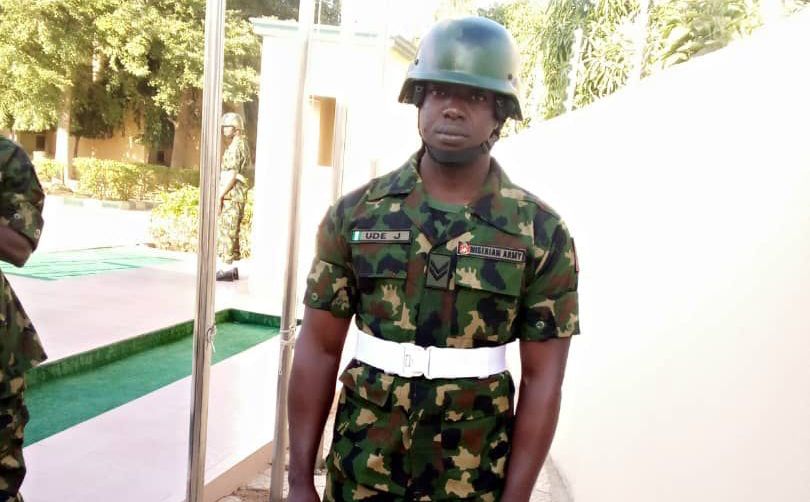
By Chuks Eke
The bereaved family of Lieutenant Jude Osondu Udeh, the army officer who was stabbed to death by yet-to-be-identified assailants at the 17 Garrison Brigade in Katsina on March 15 this year, has expressed hope that the Military High Command will, even at this late hour, choose the path of honour: to acknowledge the lapses, to offer a sincere apology, to implement corrective measures, and to ensure that no other family is subjected to such indignity.
They stated that anything less would only deepen the wound, and history is seldom kind to institutions that prefer denial over duty.
In a press statement issued on their behalf by their legal counsel, Sir Ifeanyi Ejiofor, the bereaved family expressed concern that, up until the time of filing this report, not a single kobo had been expended by the Nigerian Military for the transportation of the deceased’s remains from Katsina to his hometown in Ezeagu Local Government Area of Enugu State, nor for the settlement of mortuary expenses.
In the press statement titled “Setting the Records Straight on the Manifestly Erroneous and Misleading Account Advanced by the Nigerian Military Regarding the Disgraceful Handling of the Death and Burial of a Young Soldier, Late Jude Osondu Udeh,” the bereaved family lamented that these obligations were borne entirely by themselves, as evidenced by the payments for which documented receipts are readily available.
According to the bereaved family, “One might have expected, at the very least, that an institution so eager to claim procedural propriety would ensure its assertions were anchored in verifiable fact, rather than convenient fiction.”
“The most egregious affront lies in the complete absence of military presence at the burial. Despite due notification to the 82 Division in Enugu, not a single soldier was present to accord the deceased even the most rudimentary military honours. There was no guard of honour, no ceremonial salute, not even a symbolic representation.”
“One is compelled to ask: has the standard for honouring fallen soldiers now been so dramatically lowered that total absence qualifies as compliance? Or is this a novel doctrine in military tradition, where silence replaces the bugle and invisibility substitutes for honour?”
“The family is understandably compelled to take steps to publish visual evidence of this astonishing neglect, so that the public may judge for itself whether this constitutes the ‘full compliments’ the Military now claims to have rendered.”
“Certain commentators, perhaps unwittingly echoing official inaccuracies, have suggested that the body ought not to have been released to the family. This position is not only legally untenable but also patently inconsistent with established military practice.”
“The family of a fallen soldier retains the right to request the release of their loved one’s remains for burial. When such a request is granted, as it was in this case, it does not extinguish, diminish, or dilute the Military’s solemn obligation to accord that soldier full ceremonial honours. Honour, after all, is not a logistical inconvenience to be waived at will; it is the very essence of military tradition.”
“What is particularly concerning in this entire episode is not merely the initial lapse, grave as it is, but the subsequent attempt to obfuscate, deny, and recast events in a manner that strains credulity. Institutions earn respect not by asserting infallibility but by demonstrating the humility to acknowledge error and the integrity to correct it.”
“It would have served the Nigerian Military far better to admit, with candour, that a regrettable oversight occurred and to take immediate remedial steps. Instead, we are presented with a narrative that appears to suggest that what the world plainly did not see somehow occurred in a realm beyond evidence.”
“This is not merely about one fallen soldier; it is about the message sent to every serving officer: that in death, their sacrifice may be met not with honour but with administrative indifference and post-event revisionism.”
“The abandonment of Soldier Jude Osondu Udeh in death, after serving his nation in life, constitutes a profound moral failing. It is a disservice not only to his memory but to the very ideals the Military purports to uphold. The family does not seek confrontation; they seek truth, accountability, and dignity. These are not extravagant demands; they are fundamental obligations.”
“It is with a heavy yet disciplined sense of responsibility that we feel constrained to respond to the narrative recently circulated by the Nigerian Military—a narrative so remarkably detached from verifiable facts that one is left to wonder whether accuracy has now become optional within an institution hitherto revered for honour, order, and discipline.”
“Upon careful reading of the said account, our immediate concern was not merely the distortion it contained, but the far-reaching implications such institutional indifference to truth portends for public confidence and for the morale of those gallant men and women still risking their lives in service to the nation.”
“Indeed, it was this concern that informed the counsel to the bereaved family of the late Soldier Jude Osondu Udeh to, for now, refrain from convening a press conference to painstakingly dismantle each falsehood.”
“That restraint was advised, not out of weakness, but out of a conscious desire to preserve what remains of institutional dignity and to avoid inflicting collateral damage on the fighting spirit of personnel at the frontlines.”
However, silence must never be mistaken for acquiescence. We, the bereaved family of the late Jude Osondu Udeh, have therefore instructed our lawyer, Sir Ifeanyi Ejiofor Esq. KSC, to unequivocally state the following:
The family’s primary and consistent demand, communicated through appropriate channels including the Honourable Minister of Defence and the Chief of Defence Staff, is for a thorough, transparent, and independent investigation into the true circumstances surrounding the untimely death of their son.
“This is neither excessive nor unreasonable; it is the barest minimum owed to a soldier who paid the ultimate price in service to his country, particularly in questionable circumstances. The Military’s insinuation of financial responsibility is demonstrably false.”


