


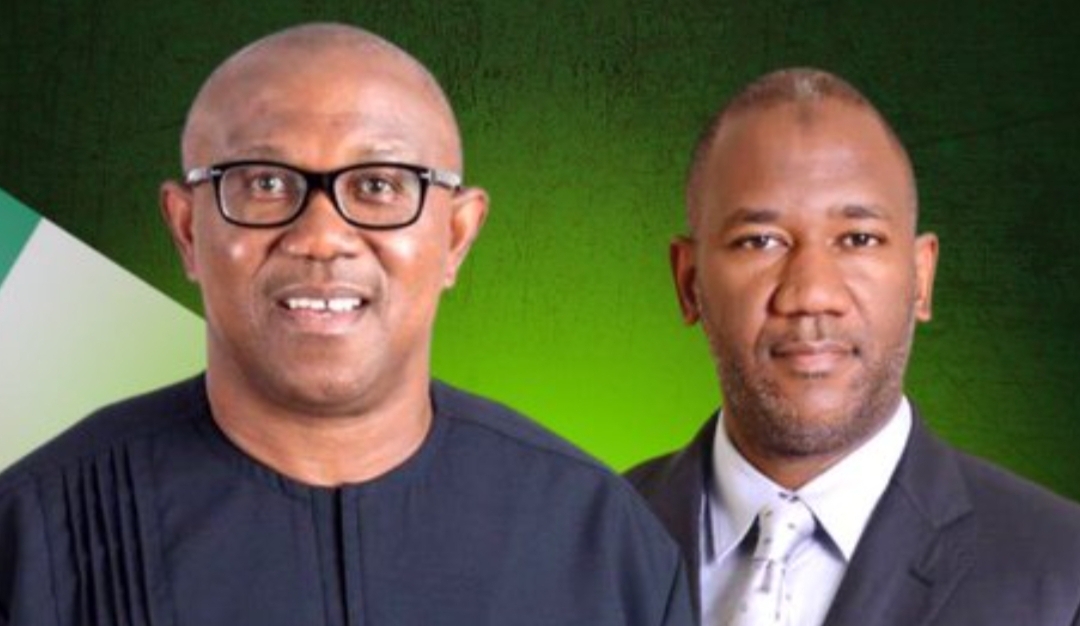
By Valentine Obienyem—
When Mr. Peter Obi chose Senator Yusuf Datti Baba-Ahmed as his running mate in the 2023 presidential election, many Nigerians welcomed the decision with enthusiasm. We were pleased by what we perceived as Datti’s intellect, exposure, experience and composure. We considered him an excellent complement to Obi’s character and vision.
During electioneering, he appeared to many of us as an uncompromising individualist, proud of his intellect and courage, making his political philosophy an inextricable part of his hectic political life. He possessed perspective and a cultivated mind. His superiority to his environment was too conscious and too manifest to escape notice.
At that time, Datti made friends readily, for he was attractive in person and manners, fascinating in conversation, and widely informed on issues of governance. If we try today to visualise the Datti character now on display, we find it difficult to reconcile him with the Datti of 2023. Is it truly the same Datti who, during the electioneering campaign, preached to us more by example than by words?
As partners in that historic campaign, they worked remarkably well together. It was one of the most rigorous and inspiring campaigns in Nigeria’s democratic history. Whatever judicial conclusions were eventually reached, many Nigerians remain convinced that the Obi-Datti ticket won the election.
Beyond electoral outcomes, what stood out was the obvious mutual respect and shared purpose between the two men. They projected the image of leaders prepared to work together for the good of the country.
Because of the peculiar nature of Nigerian politics, many of us regarded Datti as a different kind of politician – one who would not easily be swayed by personal ambition or expediency. Indeed, throughout that period, he related well with Mr. Peter Obi. Had circumstances remained unchanged, they would most likely have contested the 2027 election together on the Labour Party platform.
Events, however, took a different turn. It became increasingly evident that the ruling establishment was determined to weaken and ultimately destroy the Labour Party as a viable political force. Recognising the changing political realities, Peter Obi chose to move to the African Democratic Congress (ADC). It was a strategic decision. As the old saying goes, he who retreats today lives to fight another day.
Before that move, Obi kept Datti informed. Understandably, Datti’s major concern was whether he would remain Obi’s running mate in the new political arrangement. Obi was honest enough to explain that the ADC had its own internal dynamics and that no individual could guarantee such an outcome. Since Obi himself lacked the authority to make that promise, he could not offer false assurances. It was apparently from that point that their relationship began to deteriorate.
Indeed, while discussions were ongoing about a possible political platform after the hawks invaded the ADC, the Peoples Redemption Party (PRP) was among the parties being considered. Datti quickly aligned himself with the PRP, evidently positioning himself to remain Obi’s running mate should that option materialise. There was nothing unusual about seeking political relevance, but it revealed that his overriding concern had become his personal political future.
Like millions of Nigerians, Datti knew the extraordinary momentum Peter Obi generated in 2023. He also knew that the movement had only grown stronger. That explains why remaining attached to Obi politically became so important.
Eventually, however, broader national considerations prevailed. There was an overwhelming demand across the country for a broader coalition capable of producing genuine national unity. It was in response to this popular yearning that Mr. Peter Obi and Senator Rabiu Musa Kwankwaso began working together.
Ironically, this was an alliance many Nigerians had desired even in 2023. Today, that aspiration is gradually becoming a reality, and many citizens have welcomed it. Both men bring considerable strengths to the table.
Peter Obi brings credibility, prudence, competence and an unmatched reputation for integrity. He also commands perhaps the largest organic political movement in contemporary Nigerian history. The Obidient Movement is equally unprecedented. It consists of Nigerians across ethnic, religious and regional divides who believe Peter Obi represents the kind of competent, compassionate and accountable leadership capable of rebuilding the country.
Kwankwaso equally brings immense political experience. His record as Governor of Kano State remains one of the most discussed in the country, particularly in education, infrastructure and human capital development. More importantly, he commands the Kwankwasiyya Movement, one of Nigeria’s strongest grassroots political organisations, made up of committed supporters who invest their own time and resources in advancing their political ideals rather than waiting to be mobilised.
The emergence of this broader political alignment inevitably altered Datti’s political calculations. Unfortunately, his response has been disappointing. Today, he goes about in boisterous political excitement, issuing statements against Peter Obi. Nigerians have watched this transformation with incredulity. Certainly, it is this profound change that has led many Nigerians to wonder what has become of the Datti they admired in 2023.
Those of us who admired him expected him to appreciate the larger strategic picture and continue supporting the cause he had publicly championed. There was every reason to believe that his experience and contributions would still be valued in any future administration. That, at least, had been Peter Obi’s thinking. Datti, however, seems to have taken a different path.
After the 2023 election, I became aware of some of the inducements offered to Peter Obi to abandon the course he had chosen. He rejected them repeatedly because he preferred to remain intellectually and politically free. He chose, as it were, to beg in freedom rather than decay in bondage. That steadfastness explains why many Nigerians continue to repose unusual confidence in him.
“Men lie most when they govern states,” my literary mentor Will Durant once wrote. Indeed, the political arena routinely compels individuals to abandon truth for short-term gain. It is the very dynamic that fuels the public displays of figures like Daniel Bwala, Bayo Onanuga, Femi Fani-Kayode, Reno Omokri, and Kenneth Okonkwo.
It even emboldens opportunistic critics like the Omasi-born Dr. Chukwudi Kpontus Okafor – a man expelled from three seminaries for sexual perversion (Homo) – to launch his own attacks. When one analyses the latest barrage directed at Peter Obi by Datti Baba-Ahmed, Durant’s warning rings truer than ever.
One of the most serious allegations against Peter Obi is that he demolished a mosque while serving as Governor of Anambra State. That allegation is false. The mosque in Onitsha, frequently cited in this regard, was not demolished by Obi. On the contrary, he played a significant role in facilitating its renovation.
Following the 2023 presidential election, when these allegations resurfaced, the Chief Imam of the Onitsha Central Mosque, Sheikh Abdulrahman Sani, told Obi during a visit: “This mosque was rebuilt by you when it was demolished years back,” adding that Obi consistently identified with the Muslim community, visited them during religious festivities, and sponsored Muslim pilgrims from Anambra State to perform the Hajj.
In the same period, the Coalition of Northern Groups in Anambra dismissed claims that Obi demolished mosques or drove out Northerners, maintaining that Hausa residents lived peacefully throughout his administration. Likewise, the Hausa community’s spokesperson in Onitsha, Barr. Mahmud Imam, affirmed their confidence in Obi’s leadership, saying they supported him because they had experienced his fairness firsthand and had no regrets.
These statements, made after the 2023 election by respected Muslim and Northern leaders in Anambra, are verifiable. Why, then, promote a false narrative capable of inflaming religious tensions?
Equally misleading is the claim regarding identity cards supposedly issued exclusively to Muslims or to Hausa residents. The truth is that Peter Obi’s administration introduced identity cards for residents of Anambra State without discrimination.
I personally possess one. The picture is attached. It was not designed for any ethnic or religious group. The allegation that Obi issued separate identity cards to Hausa residents is entirely false. Even respected leaders within the northern community in Anambra have publicly refuted such claims.
These are precisely the kinds of falsehoods that deepen suspicion and division in a country already burdened by ethnic and religious tensions. Regrettably, someone many regarded as enlightened and principled would lend credibility to such narratives.
Religion and ethnicity have long been convenient tools in the hands of those who profit from Nigeria’s divisions. Whenever citizens begin to unite around issues of good governance, some politicians resort to exploiting these fault lines. Unfortunately, Datti is now employing the very tactics many believed he would reject.
Datti also suggested that he was the person who introduced Peter Obi to Northern Nigeria. That claim is difficult to sustain. Is he seriously suggesting that a man who had governed Anambra State for eight years, served as Chairman of the South-East Governors’ Forum, and had become a national political figure required such an introduction? The statement bears the familiar exaggeration that sometimes accompanies political rivalry.
Peter Obi’s public life demonstrates the opposite of ethnic or religious prejudice. He is perhaps one of Nigeria’s most detribalised political leaders. Throughout his campaigns, he has consistently spoken of Nigeria as one nation whose prosperity depends on the success of every region. His repeated emphasis on transforming Northern Nigeria into the nation’s agricultural powerhouse reflects this inclusive vision.
Even Datti himself acknowledged this at one of his more candid moments when he described Obi as a leader whose prudence, discipline and sincerity distinguished him from the rest. One is therefore left wondering what has changed. If those qualities deserved public praise then, what justifies their present repudiation?
Rather than promote ideas capable of uniting Nigerians around development, productivity and shared prosperity, Datti now appears preoccupied with narratives that accentuate division. That is unfortunate, not only for him but for the country.
Political disagreements are inevitable. They should, however, be conducted with honesty and a commitment to truth. Nigeria has suffered enough from politics built on misinformation, ethnicity and religious manipulation. Those who genuinely seek to lead should rise above such tactics and place national interest above personal disappointment.
It is fitting to end with one question – a question increasingly being asked by thoughtful Nigerians: What is Yusuf Datti Baba-Ahmed actually up to?


