


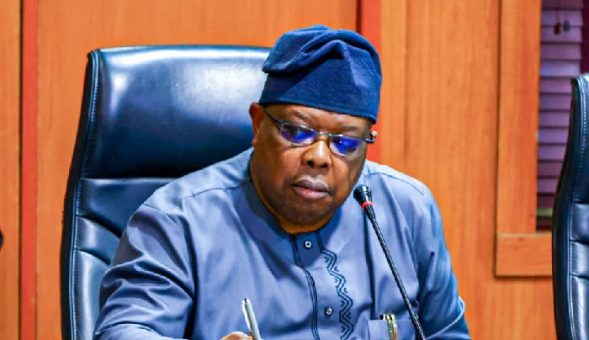
The Nigerian Government on Friday unveiled a comprehensive roadmap to overhaul Nigeria’s electricity sector, assuring Nigerians that there is no immediate plan to increase electricity tariffs while promising improved power supply, universal metering, a more reliable national grid and a financially sustainable electricity market.
Speaking at the National Media Roundtable on the theme, “Resetting the Sector,” in Abuja, the Minister of Power, Joseph Tegbe, said the administration of President Bola Ahmed Tinubu was embarking on a new phase of reforms aimed at addressing decades-long structural challenges that have hindered the country’s electricity industry.
Tegbe said the objective of the reforms was to make electricity more available and reliable, strengthen the financial viability of the market, restore investor confidence and position electricity as a driver of industrialisation and economic growth.
“The Nigerian people deserve to know where their power sector is headed, why certain decisions are being taken, and how those decisions will ultimately translate into better electricity supply for homes, businesses and industries,” he said.
He described the initiative as the beginning of a new era of openness, accountability and collaboration, stressing that “resetting the sector” was not an admission of past failures but an effort to build on the reforms already initiated under the Tinubu administration while tackling longstanding bottlenecks.
The minister credited President Tinubu with providing what he described as the strongest political commitment to electricity sector reforms since the liberalisation of the industry, noting that the implementation of the Electricity Act had created a new regulatory framework allowing states to develop electricity markets tailored to their economic realities.
According to him, the Federal Government has embraced decentralisation as an opportunity to stimulate innovation, competition and private investment across the federation.
Tegbe also disclosed that the government was advancing a Power Sector Bond Initiative to settle longstanding debts owed to electricity generation companies, gas suppliers and other market participants, describing the intervention as crucial to resolving the sector’s liquidity crisis and restoring commercial confidence.
He said universal metering remained one of the administration’s highest priorities, noting that the Presidential Metering Initiative (PMI) was designed to eliminate estimated billing and ensure consumers pay only for electricity actually consumed.
For decades, he said, estimated billing had eroded public trust between electricity providers and consumers.
The minister announced that the Ministry had already launched the Power Force, an initiative expected to engage 5,000 Nigerian youths in nationwide meter installation while simultaneously building technical manpower for the electricity industry through the National Power Training Institute of Nigeria (NAPTIN).
He also revealed that significant progress had been made in resolving long-standing challenges surrounding meter procurement.
On electricity generation, Tegbe said operational improvements were already yielding results, disclosing that Nigeria had consistently generated about 5,000 megawatts over the previous two weeks.
Although he acknowledged that generation alone would not solve the country’s electricity challenges, he said improved coordination among generation, transmission and distribution operators was beginning to produce measurable gains.
“Electricity must be generated, transmitted, distributed and paid for. All these components must function simultaneously,” he said.
To address systemic weaknesses, the minister unveiled a broad transformation agenda beginning with a comprehensive technical audit of Nigeria’s transmission infrastructure.
According to him, the audit will identify ageing facilities, overloaded substations, weak transmission corridors and operational vulnerabilities to guide future investments and reduce system failures.
The government also plans to harmonise electricity regulation between the Federal Government and state regulatory commissions following the implementation of the Electricity Act, in order to eliminate jurisdictional conflicts and provide regulatory certainty for investors.
As part of efforts to stabilise the national grid, Tegbe announced planned investments in three major transmission corridors covering Lagos, Enugu-Port Harcourt, and Abuja-Kaduna-Kano.
He added that government would also pursue strategic asset optimisation by linking underutilised electricity infrastructure to industrial clusters and manufacturing hubs while implementing a long-term Super Grid Programme to strengthen Nigeria’s transmission backbone and support future industrial expansion.
Within the next two to three years, he said Nigerians should begin to experience a stronger grid, reduced technical losses, improved market discipline, expanded electricity access and greater operational capacity across the sector.
Addressing widespread concerns over electricity pricing, Tegbe firmly dismissed speculation about an imminent tariff increase.
“There is no policy by this administration to increase electricity tariffs beyond its current level. Our priority is not tariff increase in the immediate term. Our priority is service improvement, universal metering and ensuring Nigerians pay only for the electricity they actually consume,” he declared.
He added that the government would continue to explore measures to protect vulnerable consumers while strengthening the financial sustainability of the electricity market.
Calling on investors, electricity operators, development partners, labour unions, consumer groups, state governments and the media to support the reform agenda, Tegbe stressed that success would ultimately be measured not by policy pronouncements but by improvements in the daily lives of Nigerians.
“Our ambition is clear: reliable electricity that powers our homes, competitive electricity that powers our industries, sustainable electricity that attracts investment, and inclusive electricity that reaches every Nigerian,” he said.


