


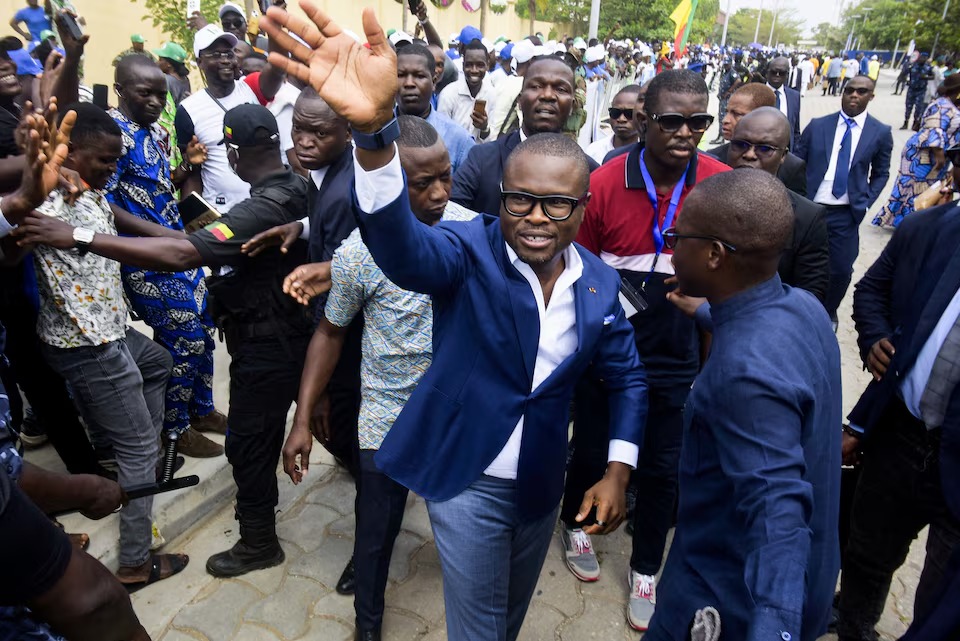
Benin’s Finance Minister, Romuald Wadagni, is widely expected to transition from behind-the-scenes technocrat to head of state on Sunday, as he runs as the clear favourite in a presidential election overshadowed by jihadist attacks in the north.
The 49-year-old former Deloitte executive has spent the past decade implementing the economic agenda of outgoing President Patrice Talon, who is constitutionally barred from seeking re-election.
His campaign highlights achievements such as tripling the national budget and recording Benin’s highest GDP growth rates in over two decades, given its status as a major cotton exporter.
President Talon’s tenure has been characterised by a consolidation of power within the presidency and the near-total marginalisation of the political opposition, smoothing Wadagni’s path to power.
Since his selection as the ruling party’s candidate last September, Wadagni has downplayed the prospect of any significant departure from the policies of the man he describes, in an interview with Jeune Afrique magazine last month, as having “almost a father-and-son relationship” with.
He has proposed creating new development hubs across the country – to better distribute industrial and tourism investment – and expanding access to healthcare, while emphasising the benefits of continuity in government.
“Under President Talon, I had the honour of managing one of your most precious assets: your money,” Wadagni told supporters in March.
If elected president, “I will approach the job with the same seriousness and dedication.”
In the early hours of 7 December, disgruntled soldiers attempted a coup, briefly seizing the state television network and coming close enough to President Talon to witness clashes firsthand.
Nigeria carried out airstrikes, and the West African regional bloc ECOWAS deployed elements of its standby force to ensure Talon remained in office. Approximately 100 alleged coup participants are currently in custody awaiting trial.
The coup plotters cited the government’s “neglect” of soldiers on the frontline in the north as a key motivation.
Benin has been the worst affected of the coastal West African states by jihadist groups that have made significant gains in the central Sahel.
Fighters linked to al-Qaeda and Islamic State have been rapidly escalating their attacks in the borderlands between Niger, Benin and Nigeria, transforming remote transit corridors into active conflict zones.
Jama’at Nusrat al Islam wal Muslimin, an al-Qaeda-linked group, killed 54 Beninese soldiers in one attack a year ago, and a further 15 in an attack last month.
“Historically, Benin has never faced a situation like this, with such serious threats and regular losses within the army,” said Gilles Yabi, founder of the West African think tank WATHI.
Wadagni has held several campaign rallies in the interior of the country – including in Parakou and Tanguieta – to demonstrate the government’s control over all its territory.
He has also pledged to establish municipal police forces in northern border towns to defend against attacks.
Wadagni was born on 20 June 1976, in Lokossa, southern Benin, and studied management, finance and auditing at Grenoble School of Management in France before joining Deloitte, where he became a partner. He has also attended courses at Harvard University in the United States.
His campaign, seeking to allay doubts about his connection to Benin after many years abroad, has emphasised his “deep roots” in the country and his “ordinary Beninese childhood”.
With the political opposition steadily weakened under President Talon, Wadagni’s victory is almost assured.
He is standing against only one candidate: Paul Hounkpe of the Cowry Forces for an Emerging Benin party, who argues that most citizens are not benefiting from President Talon’s high GDP growth and ambitious tourism projects.
The main opposition party, The Democrats, failed to secure enough parliamentary support to nominate a candidate and did not win any seats in the legislative elections in January.
Supporters of President Talon maintain that a stronger presidency is more effective in developing the country, while critics lament the shrinking political space.
If security concerns persist, the opposition could become even more constrained, according to Nina Wilen, director of the Africa Programme at the Egmont Royal Institute for International Relations in Belgium.
“There is a risk that the government will increasingly crack down on any opposition to ensure it maintains its grip on power,” she said.
“Where there is jihadist expansion, rulers want to have complete control.”


