


By Ikechi Elenwoke—
Culture is said to be the totality of a people’s way of life—their identity, traditions, beliefs, values, history, social institutions, art, language, food, music, dance, and mode of dress.
The Igbo, one of the major ethnic groups in Nigeria, occupy a prominent place among nationalities with vibrant traditions and cultures. Their flamboyant traditional costumes, dances, music, and visual arts have always made them stand out globally.
Although Igbo artists are well attuned to modern art styles, their traditional art—such as Uli patterns, traditionally used to decorate the walls of residences and the bodies of maidens—has become a major style in their art tradition and has strongly influenced modern art.
Their sculptural traditions encompass stone carvings, bronze castings, iron smelting and foundry work, traditional wood carvings, and pottery.
In recent years, the Centre for Igbo Studies at Dominican University in River Forest has been at the forefront of documenting and preserving these unique traditions and cultures, complementing the efforts of the earlier Centre for Igbo Studies at the University of Nigeria, Nsukka, established in 2014.
According to the director of the centre, Professor Nnam Nkuzi, there are two major centres for Igbo studies in the world: one at the University of Nigeria, Nsukka, and the other at Dominican University in River Forest, Illinois, a suburb of Chicago, United States. It serves as a hub where people of Igbo descent, especially scholars, come for research and to showcase Igbo culture.
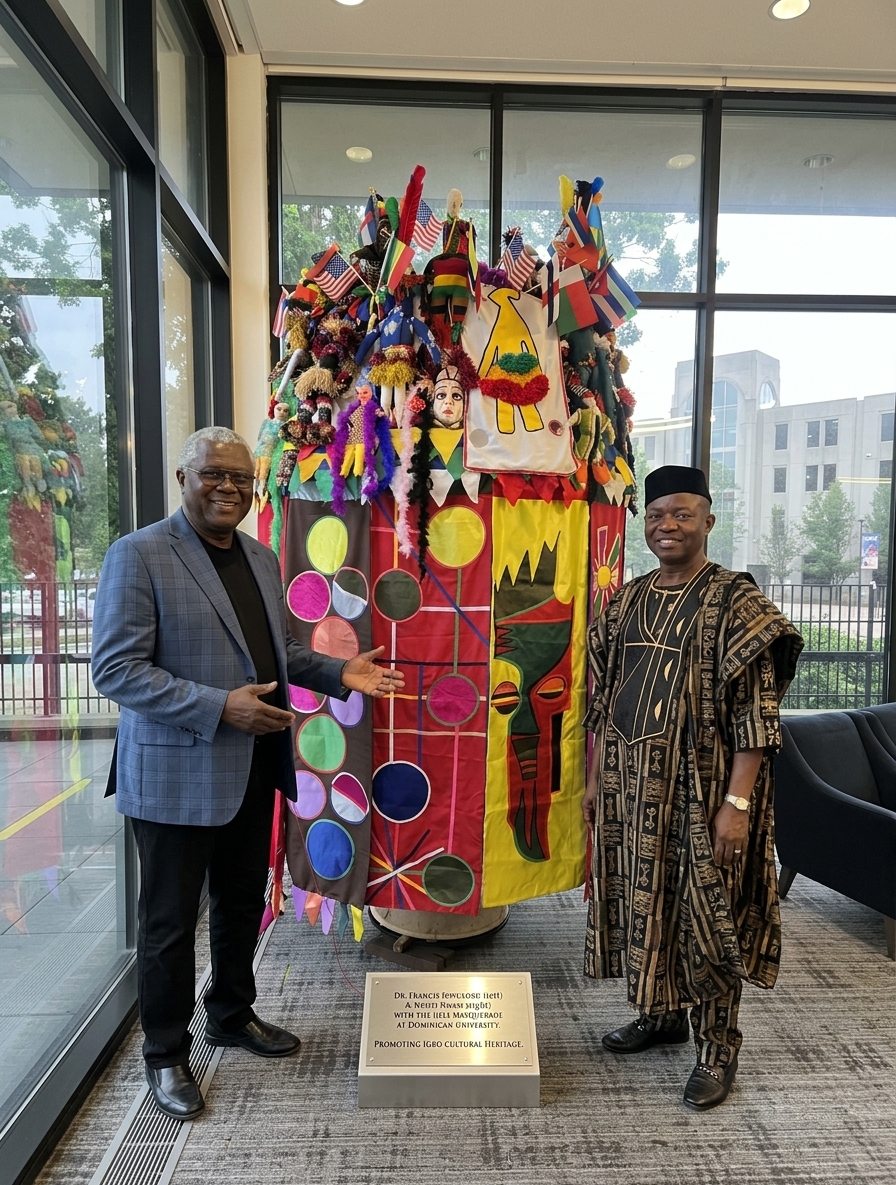
The ongoing project started about six to seven years ago. Part of our programming included the Ihencheta art exhibition recently held at the centre, which featured the works of over 50 artists from Nigeria and brought in Dr Francis Ikwuegbu and a few other professors from Nigeria as facilitators.
Dr Ikwuegbu—a teacher, sculptor, and anthropologist—was able to erect a humongous and incredible [Ijele masquerade](https://www.facebook.com/share/v/1ZhfqpX3s6/) towering up to 15 feet high.
According to Professor Nkuzi, visitors have been flocking to view the installation and make enquiries, and the centre owes Dr Ikwuegbu a debt of gratitude.
Born into a lineage of artists, Dr Ikwuegbu started his career as a wood carver, producing many masquerades within and outside his neighbourhood in Anambra State, Nigeria. He later ventured into using diverse materials, such as stone and metal, in his artistic expressions.
According to Dr Ikwuegbu, his recent project—the 15-foot-high Ijele masquerade at the Dominican University Library—is perhaps one of his larger-than-life sculptures in recent times. In his own words:
“We have other masquerades such as Omagba, Agaba, Adamma, Ojionu, and many more, but Ijele is unique.
“Everything on the masquerade has meaning. You will see elements of every other masquerade reflected in the Ijele. This king of masquerades rarely comes out except for royal outings, and it performs last at every event.
“It is big in terms of size, and it is also flamboyant and deeply respected.
“The masquerade produced in 2025 is for the Dominican University library archives—intended for academic and research purposes under the initiative of the university’s Centre for Igbo Studies in collaboration with Black World Studies.
“Everything on the masquerade has meaning. You will see the essence of every other masquerade on the Ijele. Colour symbols on it include red (mmee), representing danger; white (ihe), representing light; green (akwukwondu), symbolising life, agriculture, and vegetation; and yellow (edo). Professor Nnam Nkuzi and other enablers, like Dr K. K. Odeluga, were of great service to the project.”


